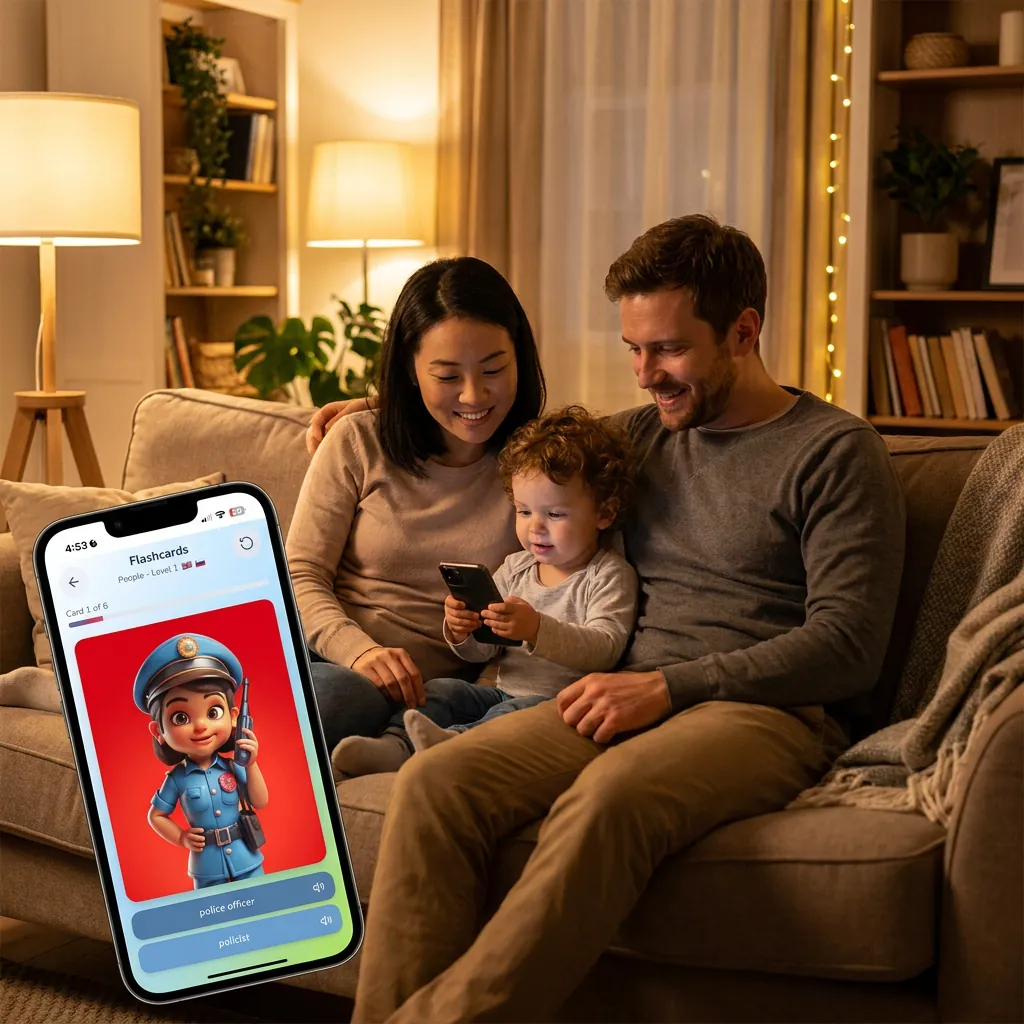

In short: heritage language loss is common and gradual, but you can slow it. Make your language the language of home, find a community that speaks it, use tools that support your language, and use real family photos and voices.
You moved abroad. Life is full. And slowly, without really noticing, your child has started answering you in the local language instead of yours.
It happens to many expat families. School speaks English (or German, or Dutch). Friends speak English. Cartoons speak English. And your language, the one your parents and grandparents spoke, tied to your identity and your culture, starts slipping away.
Why heritage languages fade so quickly
Children rarely lose a language overnight. It happens gradually: they understand more than they speak, then they speak less and less, and one day they are answering in the community language even when you speak to them in yours.
For many families the shift comes when children start school and the school language takes over. The early years, before school, are the best window to build strong foundations in your own language.
The problem: many apps are designed for a different child
Most language apps for kids assume your child already speaks one language and is learning another as a foreign language. But that isn't your child. Your child isn't learning Croatian as a school subject. You want them growing up with both languages at the same time.
When a resource treats your language as "the language being learned" and English as the starting point, it quietly reinforces the idea that English is the "real" language, which is the opposite of what you are trying to do.
What actually works for expat families
1. Make the heritage language the home language
Whatever language is spoken at home becomes associated with safety, belonging and identity. Make a rule: at home, we speak our language. Even if your child answers in English, keep going in yours. Over time, they follow.
2. Find the community
Language without community fades fast. Look for other families who speak your language: weekend schools, cultural groups, online communities. When your child sees that other kids speak this language too, it stops feeling like "just mum and dad's thing."
3. Use an app that supports your language
Many popular children's apps focus on a small set of widely spoken languages. If your family speaks Croatian, Filipino, Slovak or Swahili, yours may be missing. EveryLingo has 720+ ready-made words in 142 language options (75 languages and their regional variants), including all four of those, and it lets you add any language or dialect that isn't on the list.
Just as important, EveryLingo treats both languages as equal. Your heritage language isn't the "target." It is just as present, and just as emphasised, as the language of the community around you. That framing matters for how your child understands their own linguistic identity.
4. Use real family content
Generic word lists are a fine start, but what sticks is personal, concrete and emotionally relevant. EveryLingo lets you upload your own photos and record your own voice. Instead of a generic picture of "soup," you can use a photo of grandma's actual soup, with grandma saying the word.
The bottom line
Heritage language loss is real, and it can happen fast. The fix isn't complicated: consistency at home, connection to a community, and tools that treat both languages as equal from day one. For more on this, read why language preservation matters and our guide to raising a bilingual child.
Try EveryLingo free
Choose your languages and start playing. No sign-up needed.
Play freeFrequently asked questions
How can I stop my child from losing our home language abroad?
Keep speaking it at home even when your child answers in the local language, find other families who speak it, and give it playful daily exposure with real family photos and voices.
Can grandparents help if they live far away?
Yes. When grandparents visit or video-call, ask them to say the words while you record them. Your child then hears their voice whenever they play.
Is EveryLingo only for heritage languages?
No. It is for any family with a young child learning first words, in one, two or more languages.
What if my language isn't in the app?
You can add any language or dialect yourself, with your own words, photos and recordings.